I started learning Czech in 1997, when I began graduate school in Slavic linguistics at UNC, with a BA in Russian already behind me. My first year was built on Michael Heim’s Contemporary Czech (Slavica, 1982), a textbook that assumes many of its students already know Russian. It’s an intensive grammar course that uses real Czech and practices all four skills: reading, writing, listening, and speaking. It isn’t flashy, but linguists like me appreciate it. It’s designed to get students up to speed quickly, so that after one year they can work with authentic material like the press and films. That’s exactly what we did for the rest of my studies.
Then came many years of not speaking or writing Czech, though I kept up my listening and reading. After I retired in 2025, I refocused on speaking. I wanted ways to study on my own and get the grammar and vocabulary out of my head and into intelligible speech. Living in the US, with no immersion and no Czech speakers around most of the time, I also looked for ways to use AI as a speaking and writing partner.
These are the resources I’ve found and developed along the way. Using them, I’ve made significant progress over the past year.
Apps & Tools
These work for any language, not just Czech.
Language Reactor
Language Reactor has been around in various forms for years, well before the current wave of AI. It uses the captions on Netflix, YouTube, and other platforms to build listening and reading comprehension. It also generates exercises and keeps track of what you know and what you don’t.
Taalhammer
Taalhammer is great for shadowing and for learning in “chunks”: whole phrases and sentences, not just single words. (For the method behind this approach, see Mikel Telleria under YouTube below.) You can use its built-in AI-generated topics, but you can also upload your own topics and material. It’s focused on listening comprehension and repetition, and you can turn the written transcripts on or off.
Talkpal
A language-learning app designed specifically for speaking (or writing) practice. The app talks to you and also writes out what it’s saying, or you can turn that off and just listen.
Tandem
An app for finding free speaking partners for language exchange: you help someone with your language, and they help you with theirs.
YouTube
For learning any language
- The Linguist: Steve Kaufmann has learned 20 languages and shares the techniques and resources he uses. Frustrated with traditional methods, he built his own system, LingQ, which has a free tier. I haven’t tried LingQ, but I’ve gotten a lot out of his videos, especially his practical tips for turning what you know passively into active speaking. He talks a lot about psychology and motivation, and about language as a practice.
- Natural Language Learning: Mikel Telleria is a hyperpolyglot who speaks 12 languages, a member of HYPIA (the International Association of Hyperpolyglots), and founder of the Hyperlingua app and the Hyperpolyglot Academy. He developed his learning system at the Innovation Centre of the University of Deusto in Donostia-San Sebastián. What I like is his approach: memorize whole phrases, clauses, and sentences, and pick up the patterns as your memory of the language accumulates. He shows how to do this cheaply or for free, but I liked the approach so much that I invested in Taalhammer, which is built around the same idea. See his Hyperpolyglot Roadmap.
For Czech
- Czech Time: Lenka Suchomelová teaches Czech to foreigners and creates online courses, e-books, and other materials for intermediate and advanced learners. In her words: “Chci, aby se moji studenti češtinu naučili a bavilo je to.” (I want my students to learn Czech and to enjoy it.) I’ve taken classes with her and can vouch for her expertise and her methods. See also her website and Facebook group.
- Slow Czech: Real, everyday Czech, the language people actually speak in the hospoda, the kavárna, and at family dinners, taught through stories and conversation rather than grammar drills. It’s for learners who already know some Czech and want to start speaking it; complete beginners aren’t the target audience. They don’t list official levels, but my sense is that it suits roughly A1 to B2. They also offer tutoring through their website.
Websites
Resource hubs
- International Association of Teachers of Czech: Resources: A curated list from the IATC, including grammar references, an online Czech literary anthology, films for language teaching, pronunciation help, and links to Czech academic and cultural institutions. Useful for learners and teachers alike.
Reference and language tools
- Ústav pro jazyk český AV ČR: The Czech Language Institute of the Czech Academy of Sciences, the authority on standard Czech. Its Internetová jazyková příručka is the place to settle spelling and grammar questions.
- SEELRC Czech Reference Grammar: A free online reference grammar of Czech in English, from the Slavic and East European Language Resource Center, and a good place to look up forms and structures in depth.
- Nechybujte.cz: A free Czech language portal from Lingea, with no registration needed: a dictionary with audio pronunciation, synonyms, spelling and grammar rules, a picture dictionary, and a tool that adds missing diacritics.
- Czech National Corpus: A corpus shows you how Czech is actually used, across millions of real texts. For advanced learners it’s the best way to check which words go together and whether a phrase sounds natural. This page (in Czech) explains what a corpus is.
Czech dialects
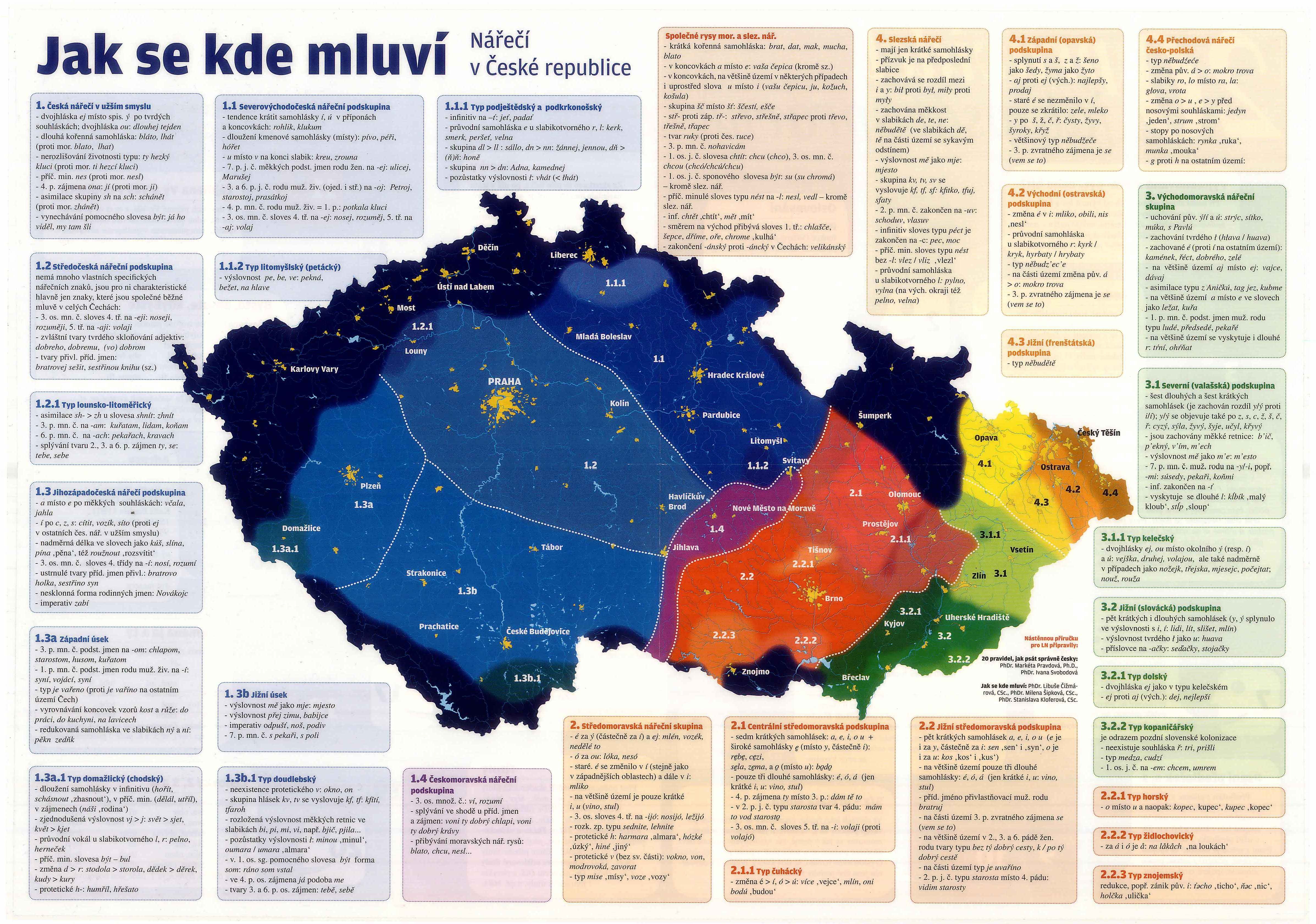
- Map of Czech dialects: Shows the dialect regions of the Czech Republic. Texas Czech grew mostly out of the Moravian dialects, with some Bohemian influence; see my Texas Czech page.
Learning Czech with AI
Here are some of the ways I use AI in my own study:
Building semantic fields and semantic frames. Instead of memorizing isolated words, I ask AI to map out the vocabulary around a topic or a situation: the related words, the verbs that go with them (with their aspect pairs), and the typical phrases. That way new words arrive already connected to each other.
A study companion for novels, TV, and podcasts. When I’m reading a Czech novel or watching a series like Vyprávěj, AI helps with much more than words and grammar. I ask about historical references I don’t recognize, why a joke is funny when I don’t get it, and why a scene would have resonated with a Czech audience at the time, and whether it still does today. It’s like having a well-read Czech friend at my elbow.
A grammar tutor on call. When a grammar point gets rusty, I ask for a quick refresher and then some practice. For example: “Refresh me on how comparatives are formed,” “Walk me through verbs of motion,” or “Help me practice clitic word order.” I get the explanation and the exercises in one conversation, at my level.
Prompts to try
A daily exercise
I use this as a daily exercise. Paste it into your AI assistant, in Czech or English; the Czech version also gets the conversation going in Czech from the start. Change the levels and the grammar topics to suit you.
Každý den mi připrav krátké cvičení češtiny na úrovni B2 s cílem postupně dosáhnout C1. Střídej mluvení, slovní zásobu a gramatiku, hlavně vid, slovosled, klitika a pády. Opravuj lehce: upozorni hlavně na chyby, které brání srozumitelnosti, a při mluvení mě nech nejdřív dokončit odpověď.
Every day, prepare a short Czech exercise for me at B2 level, with the goal of gradually reaching C1. Alternate between speaking, vocabulary, and grammar, especially aspect, word order, clitics, and cases. Correct me lightly: point out mainly the mistakes that get in the way of being understood, and when I'm speaking, let me finish my answer first.
Speaking practice with light feedback
A companion to the daily exercise: use it when you want to talk freely and get feedback at the end, instead of being corrected mid-sentence.
Při mluvené praxi mi dávej jen lehkou zpětnou vazbu a nepřepisuj celou moji odpověď. Označ, co brání porozumění nebo zní hodně nerodile. Přímo v textu upozorni na chyby v pádech, vidu a slovní zásobě. Nech mě mluvit, dokud neřeknu, že jsem skončil/a, a nepožádám o opravy.
Czech speaking practice. Give me light feedback only, with no full rewrite of what I said. Mark anything that blocks comprehension or sounds very non-native, and flag case, aspect, and word-choice issues inline. Let me keep speaking until I tell you I'm finished and ask for corrections.
Want help bringing AI into your Czech study or teaching?
The prompts above are a starting point. I’ve developed a broader set of prompts and workflows for reading, listening, speaking, and vocabulary. I work with individual learners who want to build an effective AI-assisted study routine, and with Czech teachers and tutors who want to use AI in their lessons and materials, including where it helps and where it misleads.
For Czech Teachers and Tutors
Good free materials for teaching Czech as a foreign language can be hard to find. These are worth knowing about: all are published free of charge by the organization that created them.
Complete course packages
- Česky raz dva 1 (Centrum pro integraci cizinců): One of the most complete free packages available for beginners (A1). Written for newly arrived children but adaptable, it includes student materials, a teacher edition with lesson-by-lesson guidance, worksheets, printable games, and answer keys. The activity materials may be copied for classroom use.
- Česky raz dva 2: The continuation, with 14 lessons, audio recordings, and a separate book of 44 activities with teacher keys.
Teacher manuals
- Levou zadní I, for teachers: A free lesson-by-lesson teacher manual for a course aimed at teenagers (roughly 14–18) working toward A1–A2, with target vocabulary and grammar, activities, and a linked online practice platform. The manual is free; check the terms for the student textbook before relying on it.
- Manuál výuky českého jazyka pro cizince (Integrační centrum Praha): An instructor handbook for teaching adults, built around a 100-hour beginner course that ends with preparation for the A1 exam. Useful for course planning, warm-ups (jazykové rozcvičky), and dictation ideas.
University course materials
- David S. Danaher: syllabi and teaching materials: Syllabi for four semesters of university Czech, plus courses on Václav Havel and Central European culture. The teaching materials include a Czech sounds tutorial, an outline of Czech grammar, case and conjugation reviews, materials to accompany the Step by Step textbooks, and study guides for Czech films (Dark Blue World, Loves of a Blonde, Divided We Fall) and Havel’s play Audience, each matched to a semester level. Useful for teachers planning a course, and for self-learners who want a structured path.
Supplements and samples
- Inkluzivní škola: materials by topic: Cards, worksheets, tests, and activities organized by topic (rodina, škola, jídlo, and more).
- Czech it Up! A1, lessons 1–3 (Palacký University Olomouc): A free official sample of an adult A1 textbook, useful for seeing how a professional course sequences its lessons.
- CzechClass101 worksheets: Printable vocabulary and beginner worksheets, some free with registration. A supplement, not a curriculum.
A note on copyright: a textbook being visible online doesn’t mean it’s licensed for copying. Stick to materials hosted by the publisher itself.